Calcium & Mental Fatigue
Mental fatigue creeps in unnoticed, stealing focus, dulling motivation, and slowing the mind. But what if the key to restoring clarity and energy isn’t about pushing harder but about unlocking a fundamental cellular process?
Can Calcium Sweep Away Mental Fatigue?
Mental energy is the brain’s ability to stay alert, sustain focus, and generate the motivation needed for mental and physical tasks. It is shaped by neurotransmitter activity and neural connections that regulate vigilance, emotional energy, and the drive to engage with the world. When mental energy is high, thoughts feel clear, tasks seem manageable, and motivation flows naturally. When it is low, concentration weakens, fatigue sets in, and even simple decisions feel overwhelming.
Mental fatigue occurs when prolonged cognitive effort overwhelms the brain’s ability to regulate its signals, weakening communication between neurons and making it harder to focus, remember, and process emotions. This is not just a sense of tiredness but a more profound issue where neurotransmitters are depleted, neural connections weaken, and the brain struggles to maintain efficient function.
Chronic stress triggers excessive glutamate release, leading to uncontrolled calcium entry into neurons, which disrupts their stability and slows cognitive processing. Poor calcium regulation also reduces blood flow to the brain, limiting oxygen and nutrient delivery, further worsening mental exhaustion. Calcium is essential for brain function as it controls neurotransmitter release, supports memory formation, and helps neurons process information.
When calcium signaling is disrupted, proteins like CREB—critical for learning—fail to activate, making it harder for the brain to adapt and store new knowledge. Glial cells, which help maintain a healthy brain environment, also rely on calcium to clear excess glutamate, but when this process fails, neurons become overstimulated and vulnerable to damage. Restoring calcium balance improves neural communication, strengthens synaptic function, and allows the brain to transition smoothly between focus and relaxation, preventing long-term cognitive decline.
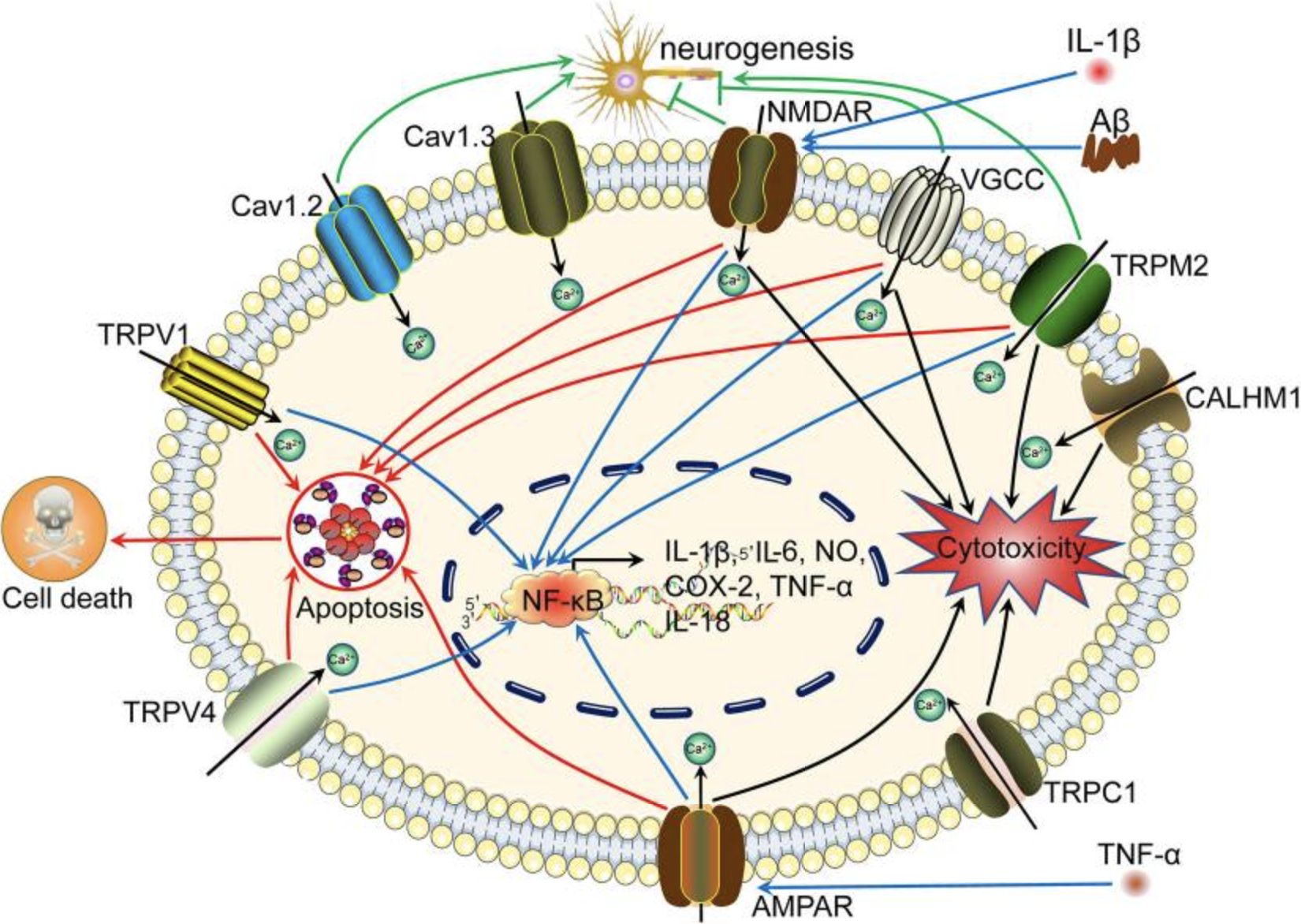
This figure explains how calcium plays a key role in brain health by controlling inflammation, nerve cell damage, new nerve cell growth, toxic effects on neurons, protection of brain cells, self-cleaning processes, and programmed cell death. Special proteins on the surface of nerve cells, called calcium transporters, help move calcium into the cells. A harmful protein called amyloid-beta can activate these transporters, including receptors and channels that control calcium entry, which causes too much calcium to enter the brain cells. When too much calcium enters the body, it can trigger brain inflammation, nerve cell damage, and even cell death through different pathways. For example, amyloid-beta activates specific calcium transporters that lead to programmed cell death, causing neurons to die over time. Additionally, some calcium transporters help regulate brain inflammation by increasing the production of inflammatory molecules and activating the self-cleaning process of brain cells.
Calcium, the Missing Link to Lasting Cognitive Energy
Calcium plays a fundamental role in neuronal excitability, synaptic transmission, and metabolic regulation, directly influencing cognitive endurance and mental resilience. Disruptions in calcium homeostasis impair neuronal reset mechanisms, prolong excitotoxic stress, and reduce synaptic efficiency, leading to persistent cognitive fatigue. AIC optimizes calcium-dependent enzymatic activity, stabilizes ion channel function, and prevents excessive intracellular calcium accumulation that leads to metabolic exhaustion.
Additionally, AIC also enhances neurovascular coupling, facilitating adequate cerebral perfusion in response to cognitive demand, thereby supporting sustained mental clarity. Unlike transient cognitive enhancers that provide temporary stimulation, AIC strengthens the fundamental neurophysiological processes required for long-term cognitive resilience and recovery.
Hidden Realities of Mental Fatigue
1: Mental Fatigue Is Just Psychological Exhaustion
FACT: Mental fatigue is not just a subjective feeling of being tired—it is a measurable neurophysiological state involving disrupted calcium homeostasis, inefficient mitochondrial ATP production, and impaired synaptic transmission.
2: Brain Energy Depletion Is Due to a Lack of Glucose
FACT: While glucose is essential for brain function, the actual energy crisis comes from dysregulated calcium signaling, which disrupts mitochondrial function and ATP synthesis, leading to prolonged cognitive exhaustion.
3: Dopamine is the Main Neurotransmitter Responsible for Mental Energy
FACT: While dopamine plays a role in motivation, acetylcholine and calcium-dependent glutamatergic activity are more directly involved in sustained attention and mental endurance.
4: Stress-Induced Fatigue Is Due to Cortisol Alone
FACT: Chronic stress triggers calcium dysregulation, excessive glutamate release, and overactivation of NMDA receptors, leading to excitotoxic stress and cognitive fatigue far beyond what cortisol alone can explain.
5: Mental Fatigue Only Comes from Overthinking
FACT: Mental exhaustion is not just about overthinking—it is a biological failure in neurovascular coupling, where the brain fails to deliver enough oxygen and nutrients to match its metabolic needs.
6: Cognitive Recovery Happens with Sleep Alone
FACT: Sleep is essential, but if calcium homeostasis remains dysregulated, neurons struggle to reset properly, leading to persistent mental fatigue even after rest.
Advanced Clinical Perspectives Through the Molecular Lens
1. Neurons Struggle to Reset After Mental Effort Prolonged cognitive activity requires ion pumps to restore balance, but inefficient sodium, potassium, and chloride clearance keeps neurons overstimulated, slowing processing and prolonging fatigue.
2. Mitochondria Process Energy Differently in the Brain Unlike muscles, neuronal mitochondria rely on calcium signals for ATP production. Excess calcium disrupts this process, causing oxidative stress and depleting mental energy.
3. Glial Cells Are Key to Cognitive Recovery. Astrocytes and oligodendrocytes regulate neurotransmitter recycling and calcium homeostasis. When impaired, neurons lose metabolic support, leading to slower cognitive recovery.
4. Gut-Brain Inflammation Contributes to Mental Fatigue Dysbiosis and altered tryptophan metabolism drive neuroinflammation, shifting resources away from serotonin and increasing fatigue-related pathways.
5. The Blood-Brain Barrier Weakens Under Stress High cognitive demand temporarily increases BBB permeability, allowing inflammatory molecules to disrupt calcium balance and synaptic activity, prolonging mental exhaustion.
How Brain Circulation Fuels Mental Stamina
Subclinical impairments in brain circulation can develop early, often before any visible structural damage appears. In the initial stages of minor vessel dysfunction, oxygen delivery to high-demand brain regions becomes less efficient, affecting cognitive stamina. These subtle changes can prolong mental fatigue and slow processing speed, even when no apparent neurological deficits exist. As a result, neurons experience metabolic strain, making cognitive recovery more complex.
Conclusion
Restoring optimal calcium signaling is key to overcoming mental fatigue at its root, as it directly influences neurotransmitter function, synaptic efficiency, and neurovascular balance. As seen in brain physiology, calcium is not just a structural element but a fundamental regulator of cognitive endurance, playing a critical role in neuronal excitability, ATP synthesis, and metabolic stability. When calcium homeostasis is disrupted, neurons struggle to clear excess glutamate, leading to prolonged cognitive exhaustion and inefficient neural reset mechanisms. Additionally, the neurovascular system relies on precise calcium-dependent signaling to ensure proper cerebral blood flow, highlighting its impact beyond simple neuronal function. Traditional approaches to cognitive recovery often overlook the role of calcium in sustained mental clarity and resilience, focusing instead on temporary stimulants that fail to address the underlying dysregulation. However, targeted interventions can enhance neurophysiological efficiency and optimize mental stamina by supporting calcium-dependent enzymatic activity and stabilizing ion transport mechanisms. AIC therapy offers a promising avenue for those seeking to restore cognitive energy, maintain neurological integrity, and prevent the long-term consequences of chronic mental fatigue.
Bring calcium signaling into your practice.
Practitioners can request a consultation to discuss AIC therapy and how these mechanisms apply to specific cases.
Newsletter content is educational and contributed by participating healthcare practitioners. These statements have not been evaluated by the FDA and are not intended to diagnose, treat, cure, or prevent any disease.