A researcher looking into a microscope in a calcium research laboratory
Antiorbital Ionic Calcium · ACRI

AIC Therapy: Driving decalcification and restoring calcium signaling to unlock the body’s natural healing pathways.

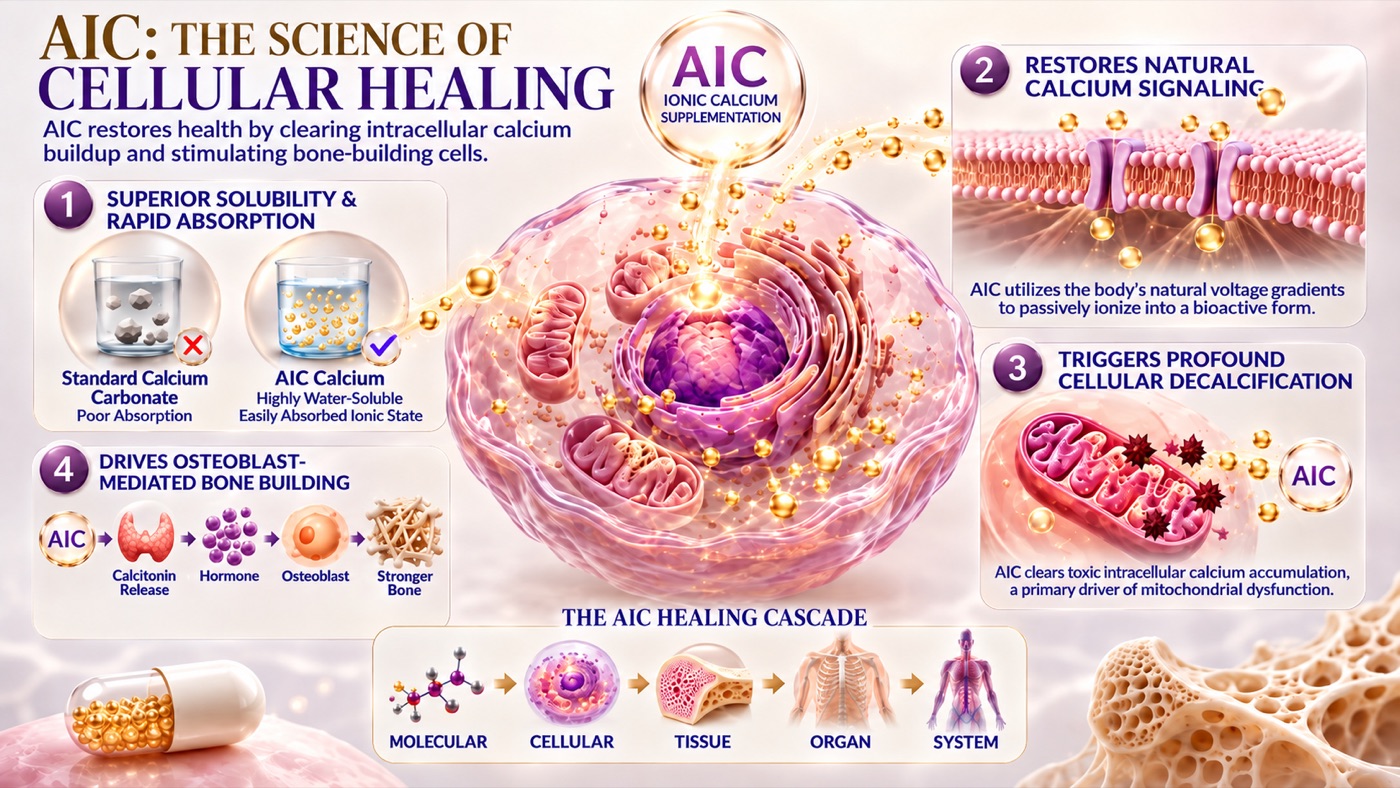
AIC triggers profound cellular decalcification—a vital physiological pathway for cellular healing. Unlike standard calcium carbonate, AIC is highly water-soluble and exists in an easily absorbed, ionic state. This makes it uniquely equipped to combat intracellular calcium accumulation, which is a primary driver of mitochondrial dysfunction across many diseases. By providing a targeted mechanism to clear this toxic buildup and restore calcium signaling, AIC utilizes the body’s natural voltage gradients to passively ionize into a highly bioactive form. This overcomes the absorption limits of traditional calcium compounds and directly stimulates the body's natural release of calcitonin. For patients, AIC intake safely elevates serum ionized calcium and drives osteoblast-mediated bone building.

Infographic, AIC: the science of cellular healing. AIC restores health by clearing intracellular calcium buildup and stimulating bone-building cells: 1, superior solubility and rapid absorption, AIC calcium being highly water-soluble where standard calcium carbonate is poorly absorbed; 2, it restores natural calcium signaling, using the body's voltage gradients to ionize into a bioactive form; 3, it triggers profound cellular decalcification, clearing the intracellular calcium that drives mitochondrial dysfunction; 4, it drives osteoblast-mediated bone building, from calcitonin release to stronger bone. The AIC healing cascade runs from molecular to cellular, tissue, organ and system.
In research collaboration with
Moffitt Cancer Center UAMS Rockefeller Cancer Institute Calcium & Bone Health Institute
Presented at
AACR 2025 · Chicago ASBMR 2025 · Seattle
AIC Therapy

What is AIC Therapy?

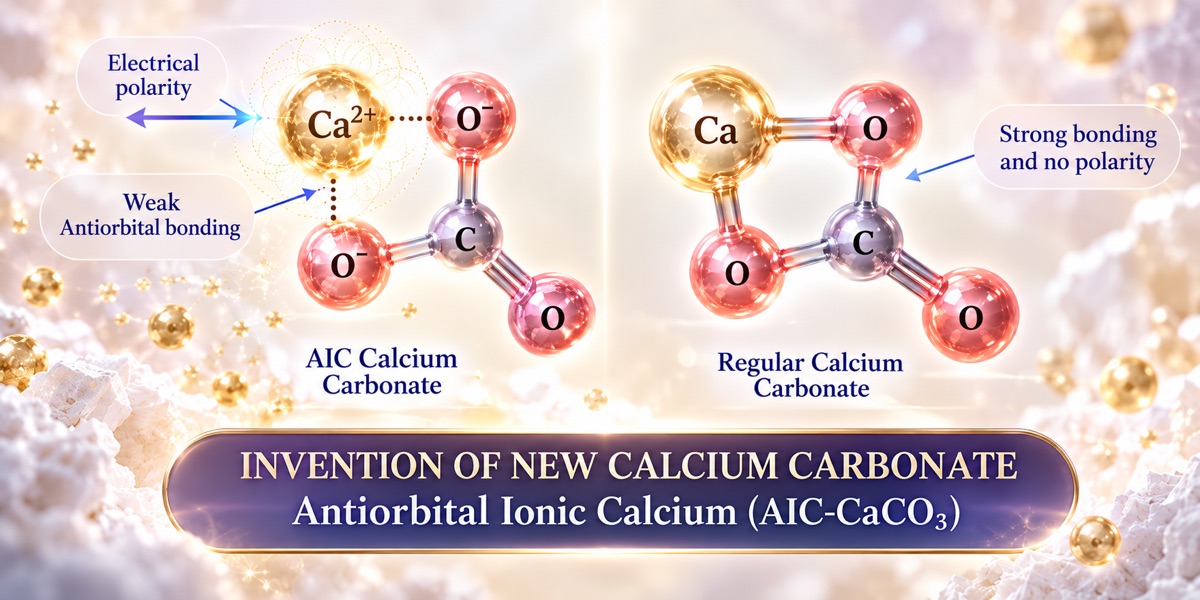
AIC features ionic calcium with weakened antiorbital bonding interactions, which significantly increases the proportion of free, bioavailable ions. Rather than relying on extensive enzymatic digestion or peptide-mediated transport, AIC facilitates passive ionic absorption directly across the gastric mucosa through simple diffusion and hydrostatic pressure, allowing the body to access and utilize calcium in its most physiologically active form almost immediately. In contrast, traditional calcium supplements fall short because they increase total circulating calcium without delivering this biologically active form. Much of this conventional calcium ends up bound to proteins or trapped in temporary complexes, failing to initiate immediate cellular signaling.

Once absorbed, this rapid delivery of free calcium ions directly jumpstarts intracellular functions and restores widespread physiological balance. Because ionized calcium is the active form, restoring this cellular homeostasis is a critical step in correcting disorders involving impaired calcium regulation. AIC improves mitochondrial function and normalizes calcium distribution throughout the entire body. This enhanced availability governs endocrine regulation—specifically involving the thyroid and parathyroid glands—which restores calcium-dependent signaling across cardiovascular, neurological, immune, and enzymatic systems. By doing so, it physiologically mobilizes excess calcium away from soft tissues where it doesn't belong.

AIC therapy ultimately stimulates healthy skeletal turnover and drives calcium directly into bone building. According to published research by Yoon et al., this increased extracellular ionized calcium drives osteoblast differentiation and establishes improved bone mineral density, remarkably without requiring vitamin D for transport.1 These findings establish AIC as a highly effective strategy for preserving bone health and systemic calcium balance.

Diagram comparing AIC calcium carbonate, whose calcium ion has electrical polarity and weak antiorbital bonding, with regular calcium carbonate, which has strong bonding and no polarity: the invention of a new calcium carbonate, Antiorbital Ionic Calcium (AIC-CaCO3).

Free, Bioavailable Ionic Calcium

AIC carries ionic calcium with weakened antiorbital bonding, which raises the proportion of free ions. Absorption occurs by passive diffusion across the gastric mucosa, without enzymatic digestion or peptide-mediated transport. Conventional supplements raise total circulating calcium, but much of it remains protein-bound and never reaches the active form.

Restoring Calcium Signaling

Free calcium ions reach the cell directly and re-engage intracellular signaling. AIC improves mitochondrial function and normalizes calcium distribution in the body. Enhanced availability supports thyroid and parathyroid regulation, which restores calcium-dependent signaling across cardiovascular, neurological, immune, and enzymatic systems.

Bone Formation and Mineral Density

Published clinical research reports improved bone mineral density in older adults taking AIC.1 In separate preclinical research on ionic calcium, mice on a calcium-deficient diet showed increased trabecular bone volume and no bone deterioration, with no toxic effects observed.6

Applications

Applications of AIC Therapy.

Calcium signaling regulates processes in nearly every cell type, which is why AIC Therapy applies to all of these conditions.

For practitioners

Why practitioners partner with ACRI.

In practice, preserving skeletal integrity as patients age often compromises systemic calcium homeostasis, and that imbalance disrupts cellular communication far beyond bone density loss. Calcium ions are not only structural components but universal messengers coordinating energy metabolism, hormone secretion, and gene expression, and their dysregulation drives chronic metabolic, cardiovascular, and neurodegenerative conditions. Our work reframes calcium as a dynamic biological messenger rather than an inert building block, restoring network-level equilibrium by modulating these cellular pathways. This is a mechanism-driven approach that safeguards skeletal reserves while restoring healthy cellular dialogue.

For Practitioners →
Clinical cases

Clinical cases.

Written for healthcare practitioners and provided for educational purposes only. They are not medical advice for any individual patient and do not replace clinical judgment.

  • Bone & Joint Health

    Treatment-Resistant Fibromyalgia

    43-year-old female · Canada
  • Neurology & Psychiatry

    Neurobehavioral & Autonomic Dysregulation

    Three observations reported in practice
About ACRI

About ACRI.

At the Advanced Calcium Research Institute (ACRI), we are changing how complex diseases are treated by fixing the body's underlying calcium balance. Unlike standard supplements that can cause harmful buildup, our unique Antiorbital Ionic Calcium (AIC) technology is absorbed directly into the body. This allows us to safely clear misplaced calcium out of soft tissues and redirect it to build healthy, strong bones. Ultimately, we study its application in conditions such as osteoporosis, arthritis, cancer and neurodegenerative disorders.

Research partners including UBC, Simon Fraser University, Hope4Cancer, University of Miami, UAMS, University of Victoria and Moffitt Cancer Center
Contact

Got any questions?

A team of experts will answer your inquiries promptly. Dr. Server Bozdogan and his team are eager to collaborate with healthcare practitioners.

Your message is sent to the AIC team at info@aictherapy.com. We reply by email, usually within two business days.

References

  1. Yoon D, Lee A, Yusuf I, Putranto T, Setiawan L, et al. A Potent Calcium Dietary Consumption Improves Bone Mineral Density in Asian Older Adults. J Family Med Prim Care Open Acc. 2025;9:290. https://doi.org/10.29011/2688-7460.100290
  2. Choi SY, Park D, Yang G, Lee SH, Bae DK, Hwang SY, Lee PK, Kim YB, Kim IH, Kang HG. Effects of Sigma Anti-bonding Molecule Calcium Carbonate on bone turnover and calcium balance in ovariectomized rats. Lab Anim Res. 2011 Dec;27(4):301-7. doi: 10.5625/lar.2011.27.4.301. Epub 2011 Dec 19. PMID: 22232638; PMCID: PMC3251760.
  3. Bozdogan S, Lee P, Turkseven CH, Yetkin D. Preclinical evaluation of anti-orbital ionic calcium compounds reveals differential Annexin V/PI-Defined cell death profiles in MCF-7 breast cancer cells. Mol Biol Rep. 2026 May 12;53(1):750. doi: 10.1007/s11033-026-11937-1. PMID: 42118333.
  4. Khairullah, A. R., Kurniasih, D. A. A., Maruf, I. F., Pratama, B. P., Sukmanadi, M., Ansori, A. N. M., Mustofa, I., Wardhani, B. W. K., Ahmad, R. Z., Martindah, E., Mulyati, S., Yulianti, W., Furqoni, A. H., Rehman, S., Wibowo, S., & Utari, F. (2026). Calcium Signaling Pathways in Physiological Regulation and Disease Development: A Comprehensive Review. Trends in Sciences, 23(4), 12261. https://doi.org/10.48048/tis.2026.12261
  5. Nguyen RL, Medvedeva YV, Ayyagari TE, Schmunk G, Gargus JJ. Intracellular calcium dysregulation in autism spectrum disorder: An analysis of converging organelle signaling pathways. Biochim Biophys Acta Mol Cell Res. 2018 Nov;1865(11 Pt B):1718-1732. doi: 10.1016/j.bbamcr.2018.08.003. Epub 2018 Aug 9. PMID: 30992134.
  6. Herrera-Rodríguez SE, García-Márquez E, Padilla-Camberos E, Espinosa-Andrews H. Evaluation of an Ionic Calcium Fiber Supplement and Its Impact on Bone Health Preservation in a Dietary Calcium Deficiency Mice Model. Nutrients. 2022;14(3):422. doi:10.3390/nu14030422. PMID: 35276779.

Clinical case

These clinical cases are written for healthcare practitioners and are provided for educational purposes only. They are not medical advice for any individual patient and do not replace clinical judgment.