Listen to this issue
This newsletter reveals how depression can emerge not just from neurotransmitter imbalance, but from blocked intracellular calcium signaling—a deeper disruption in brain cell communication
Executive Summary
Depression often reflects a breakdown in calcium rhythm across the brain’s emotional networks.
When calcium can’t flow between cellular compartments, neurons lose their ability to reset and adapt.
AIC therapy reestablishes this intracellular signaling, helping restore mood regulation at its molecular source.
Why Emotional Recovery Depends on Calcium Timing—Not Just Chemistry
When we treat depression as merely a neurotransmitter deficit, we risk missing the deeper cellular misfires beneath it. Calcium signaling is not just for bones; it shapes how the brain times its emotional and thinking signals. Inside the brain, calcium governs not just how signals fire, but when they reset. That “reset” matters.
If intracellular calcium levels build up for too long in emotional centers, such as the amygdala or hippocampus, neurons lose their adaptability. The result? Rumination, low mood, or brain fog that doesn’t match the stressors. Meanwhile, impaired calcium clearance can block the reuptake of excitatory activity, making calmness harder to reclaim. Some patients may feel chronically overwhelmed, not from overthinking, but from dysregulated glial calcium tone. This is exactly where inflammation, sleep quality, and emotional health come together.
For example, a lack of REM sleep can trap calcium in hippocampal neurons, weakening emotional memory filtering. Gut inflammation? It may raise TNF-α and IL-6, which subtly interfere with calcium-buffering proteins in astrocytes. Even mitochondrial fatigue, when calcium flux between the ER and mitochondria slows, can flatten energy and emotional variability.
Many patients presenting with “low motivation” or “emotional burnout” actually exhibit signs of persistent intracellular calcium buildup in limbic circuits, rather than a lack of willpower. In these cases, magnesium, omega-3s, and B vitamins may help, but only when calcium flux and buffering systems are functioning properly. Actual improvement comes not just from adding inputs, but restoring the rhythm of signal flow itself.
When cells can’t recalibrate, neuroplasticity dulls, and coping mechanisms fail. Getting this rhythm back doesn’t need drastic steps—it starts by seeing calcium as a quiet emotional guide. In fact, one of the brain’s key rhythm keepers—CaMKII—relies on calcium not just to activate, but to remain active through autophosphorylation, even after calcium levels decline. In the hippocampus and cortex, high-frequency calcium pulses trigger this kinase to lock in a memory, repair a synapse, or reshape mood responses. However, when calcium misfires or accumulates in the wrong compartments, CaMKII remains unstable, and the reset process never completes.
For patients stuck in emotional reactivity or flatness, this may not be about a lack of neurotransmitters , but rather calcium’s failure to engage the very proteins that convert fleeting signals into lasting resilience.
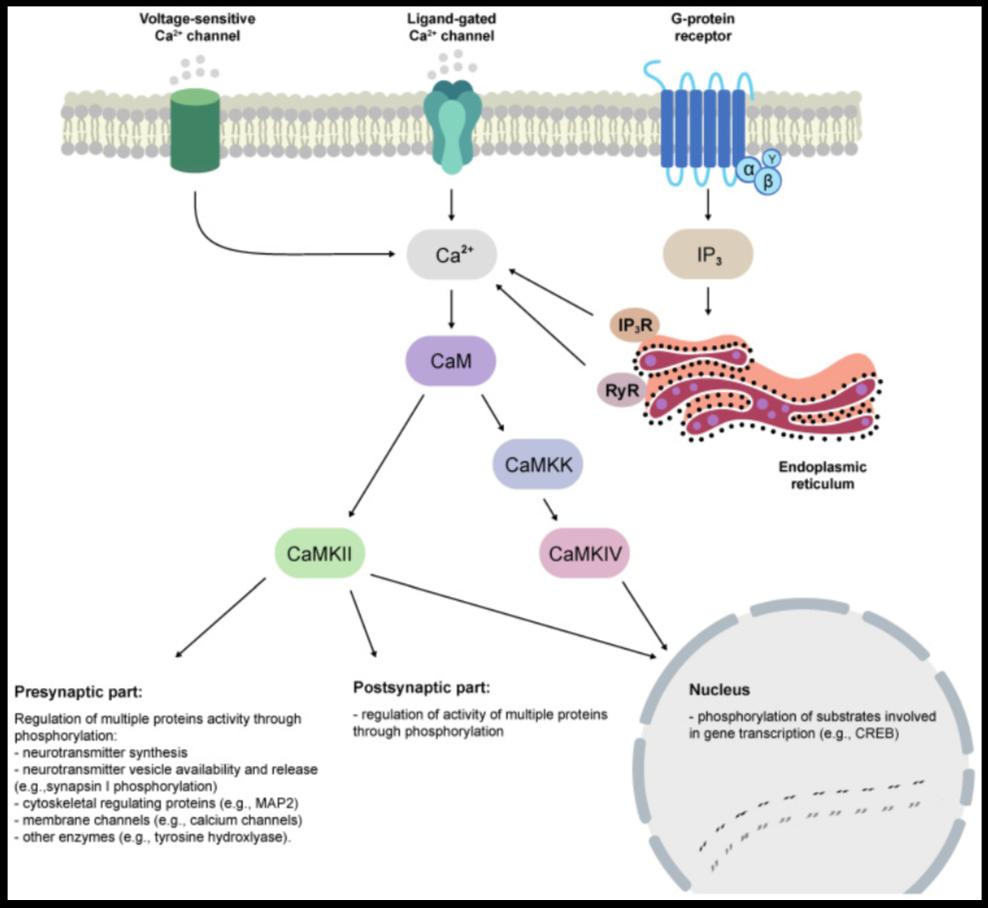
This figure illustrates how calcium signaling activates key enzymes that help the brain adapt, process emotions, and form memories. When calcium levels rise inside a neuron—whether from stimulation at the surface or from internal storage—it binds to a protein called calmodulin. This binding activates two major response systems: one directly turns on an enzyme called CaMKII, and the other leads to activation of CaMKIV through an additional step. These enzymes influence how brain cells change over time, helping regulate gene expression and emotional resilience. In short, this calcium-triggered chain acts like a molecular tuning system for how the brain responds to stress and learns from experience.
Sałaciak K, Koszałka A, Żmudzka E, Pytka K. The Calcium/Calmodulin-Dependent Kinases II and IV as Therapeutic Targets in Neurodegenerative and Neuropsychiatric Disorders. Int J Mol Sci . 2021;22(9):4307. Published 2021 Apr 21. doi:10.3390/ijms22094307
Reactivating Brain Resilience Through Calcium Flow
AIC therapy restores calcium rhythm in the emotional centers of the brain. It clears intracellular calcium congestion in the hippocampus and amygdala, allowing neurons to reset and re-engage with precision. This reactivation enhances synaptic plasticity, stabilizes glial function, and restores the energy circuits that support emotional adaptability. AIC directly reestablishes calcium flow between the endoplasmic reticulum and mitochondria, which is essential for mood regulation and neuroplastic repair. By rebalancing these ionic pathways, AIC initiates lasting change in patients with chronic emotional exhaustion and stalled recovery.
What Depression Doesn’t Always Show You
Four overlooked intracellular disruptions that can block emotional recovery.
- Normal lab results don’t rule out silent inflammation inside brain cells. Even with low CRP or cytokines, microglial stress and astrocyte calcium imbalance can persist.
- Healthy-looking sleep doesn’t mean calcium is clearing properly during the night. Calcium may remain trapped in hippocampal neurons, silently dulling emotional recovery.
- Balanced neurotransmitters don’t always mean brain circuits are adapting correctly. If calcium timing is off, synapses may stop responding, even with perfect serotonin levels.
- Clean brain scans can still miss hidden calcium blockages between the ER and mitochondria. These traffic issues can quietly limit energy, resilience, and emotional variability.
Case Reference
A 53-year-old woman with knuckle and knee arthritis reported worsening pain that disrupted her sleep, daily activities, and led to depression. Conventional treatments and supplements offered little relief, leaving her dependent on nightly heating pads.
After beginning AIC therapy, both joint pain and swelling reduced noticeably within ten days, restoring her mobility and energy. As inflammation subsided, emotional stability also improved, with a visible lift in mood and daily resilience. While depression wasn’t the initial treatment focus, the recovery appears to have been influenced by restored calcium signaling across both musculoskeletal and neural systems. This resolution of intracellular calcium congestion likely supported mood recalibration directly—offering a clinically relevant bridge between physical and emotional health.
Conclusion
Depression often hides beneath a surface of normal labs and clean scans, but calcium signaling tells a deeper story. When calcium flow between the endoplasmic reticulum and mitochondria is disrupted, emotional centers lose their flexibility and energy renewal. The figure in this issue shows how this breakdown affects enzyme activation in memory, mood, and repair. Hidden patterns like glial congestion or blocked CaMKII activation often explain why symptoms linger even after neurotransmitters normalize. AIC therapy restores this rhythm, giving patients a new path forward, not by altering mood directly, but by removing the cellular silence beneath it.
Bring calcium signaling into your practice.
Practitioners can request a consultation to discuss AIC therapy and how these mechanisms apply to specific cases.
Newsletter content is educational and contributed by participating healthcare practitioners. These statements have not been evaluated by the FDA and are not intended to diagnose, treat, cure, or prevent any disease.