Listen to this issue
Here’s how calcium timing connects sleep depth, morning clarity, and cognitive aging, with a simple signal map you can use.
Executive Summary
Cognitive aging often presents as brain fog, slower recall, and mood volatility, but a frequent hidden driver is flattened 24-hour calcium-signaling that keeps neurons and mitochondria in a constant low-grade “work mode.” Restoring the contrast of calcium timing, together with a signal-guided mineral approach that supports steadier ionic calcium handling, can quietly improve sleep depth, autonomic calm, and cognitive sharpness without requiring dramatic shifts in standard lab panels.
Calcium Pulses Set the Cellular Clock
Most conversations about circadian rhythm stay with melatonin, screens, and bedtime habits. However, it is crucial to understand that inside the cell, timing is carried by calcium pulses that rise sharply when tissues need to act, then drop low enough for recovery chemistry to dominate. When this contrast is preserved, many patients report quieter nights, lighter mornings, and fewer daytime swings in pressure and glucose. When the pattern flattens, the body behaves as if it is running a few hours off schedule, and the person can feel jetlagged inside their normal week.
In practice, these rhythms depend on a fairly steady ionic calcium environment outside the cell and on membranes and mitochondria handling short bursts rather than a constant leak. If free calcium in plasma and interstitial fluid drifts too high or too low, channels tend to hover in an “almost open” state, mitochondria retain calcium longer than they should, and cellular 24-hour contrast loses definition. AIC therapy is used as a focused calcium preparation in this setting, with the intention of supporting calcitonin, nudging surplus calcium back toward bone, and taking some of the chronic load off excitable tissues and mitochondria. The target is not “fixing” serum calcium that may already read normal, but lowering background noise so intracellular calcium signals recover a clearer shape.
Alongside this, simple timing work still matters: morning light, regular sleep and wake hours, defined meal windows, and modest movement spread through the day. AIC then sits as the mineral part of that plan. Together, they are directed at patients who describe light or broken sleep, heavy mornings, early blood pressure spikes, palpitations on waking, or energy that peaks at the wrong time of day despite a reassuring lab report. For that group, treating ionic calcium and circadian cues in the same frame offers a practical way to pull sleep, mood, heart, and metabolism back into the same clock.
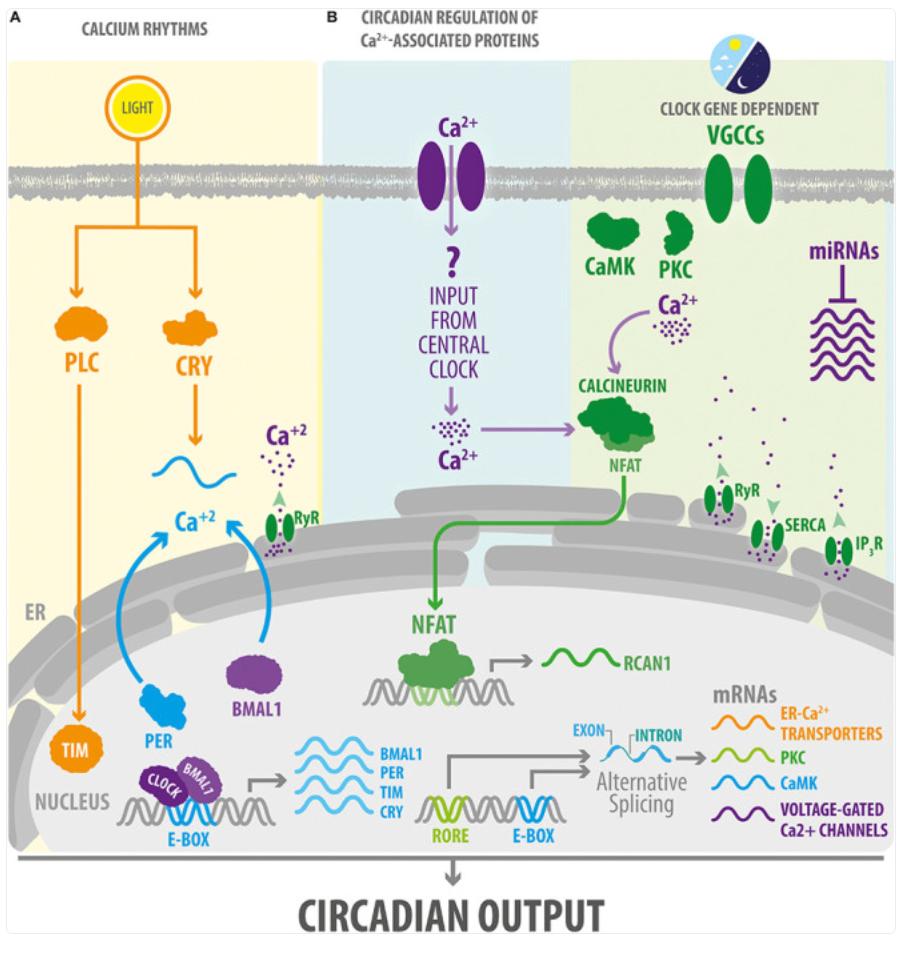
This figure shows how the body clock gives intracellular calcium signaling its own day-and-night rhythm. Light entering the system and other upstream signals reset the central clock by shifting the timing of the main clock gene loops, and these loops then set the pattern of calcium swings within clock neurons, including controlled calcium release from and reuptake into the endoplasmic reticulum in the suprachiasmatic nucleus.
The same clock system also times the daily expression of many calcium-related channels, pumps, and regulatory proteins through gene control and later steps, such as alternative splicing and microRNAs, so the calcium machinery itself is not constant over 24 hours. In peripheral tissues like skeletal muscle and heart, this timing appears as a precise rhythm in the calcium–calcineurin–NFAT pathway, meaning calcium-driven gene programs in these organs follow a predictable daily pattern rather than a flat baseline.
Cavieres-Lepe J, Ewer J. Reciprocal Relationship Between Calcium Signaling and Circadian Clocks: Implications for Calcium Homeostasis, Clock Function, and Therapeutics. Front Mol Neurosci. 2021 May 11;14:666673.
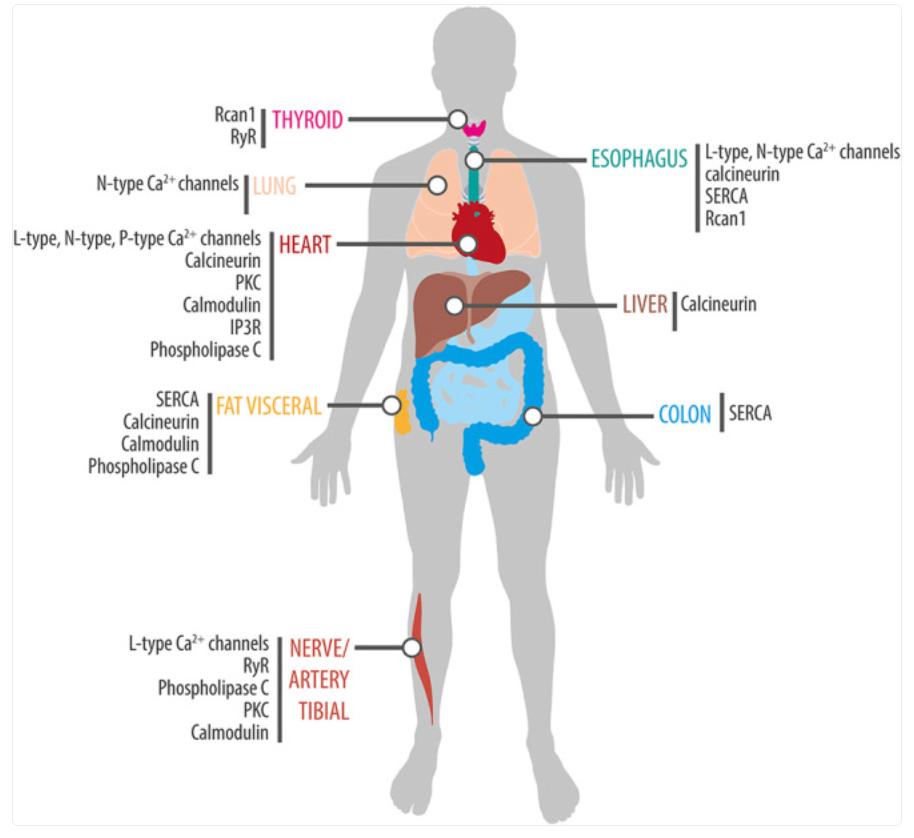
This figure shows the rhythmic expression of calcium signaling components in human tissues. It is based on a circadian database from Ruben and colleagues, which found that many genes encoding Ca²⁺ signaling proteins follow a daily rhythm of expression in different peripheral clocks. These human data are consistent with earlier transcriptomic studies in mice and baboons that reported circadian variation in calcium-related genes across multiple tissues and brain regions. In the schematic, each peripheral human tissue has its own circadian pattern of expression for Ca²-associated proteins, channels, and transporters. The above figure links this rhythmic target expression to the idea that timing drug administration to the peak expression of its target can improve treatment of cardiovascular disease, hypercholesterolemia, and obesity.
Cavieres-Lepe J, Ewer J. Reciprocal Relationship Between Calcium Signaling and Circadian Clocks: Implications for Calcium Homeostasis, Clock Function, and Therapeutics. Front Mol Neurosci. 2021 May 11;14:666673.
Calcium Signal Clinical Map
This kind of patient story has increased the importance of using a simple “signal-guided map” in daily practice. The map starts with one question: which tissues are complaining first, and what might their ionic calcium signal look like?
Morning headache, neck tightness, and early pressure spikes pull attention toward vascular smooth muscle and endothelium. Night gut cramps, restless legs, and racing thoughts in bed point more to enteric neurons, skeletal muscle, and brain circuits that may be running on a slow-to-clear calcium background rather than on short, precise pulses. For each zone, the same checklist can be used: Is extracellular ionic calcium reasonably stable? Do excitable membranes ever fully reset? And do mitochondria have sufficient low-calcium time to refill ATP?
Drug history, acid-base balance, magnesium intake, low-grade inflammation, caffeine, alcohol, and irregular meal timing then act as practical clues for how hard those tissues are being pushed. When several areas line up on the page, the picture often shifts from a single organ problem to a body that has lost contrast between day and night in its calcium traffic. Treatment plans built on this map usually keep standard tools in place but give more weight to mineral balance, food timing, stimulant control, light exposure, and gentle movement spread across the day so that ionic calcium exposure becomes more rhythmic again. The clinical target is simple and concrete: a person who falls asleep with less effort, wakes with a clearer head, and carries steadier pressure, mood, and glucose through an ordinary week.
Signs of Disrupted Calcium Timing
Many patients arrive after years of adding one symptomatic drug on top of another, while disordered calcium signalling inside their cells has never been addressed. Once that background is taken seriously, a mineral-based intervention starts to look less like a supplement and more like a way to reset how tissues respond to ordinary stress. The practical question then is not just where calcium appears on imaging, but how fast a small pulse of ionic calcium is cleared and the membrane settles back to a stable electrical and metabolic state.
When clearance is slow, pain flares last longer, orthostatic swings are sharper, and small emotional triggers can produce a full-body response that looks larger than the event itself and tends to recur at similar points in the day. At that stage, attention shifts from adding another drug to finding ways to make calcium pulses shorter, less sticky in the cytosol, and less costly for redox balance and enzyme control, so that cells can again separate periods of effort from periods of repair. AIC fits into this space as a background signal therapy rather than an acute rescue, used to steady the set point of calcium handling in excitable and metabolic tissues.
With a controlled rise in ionized calcium, AIC activates CaSR and stimulates endogenous calcitonin, so excess calcium leaves soft tissue and moves back toward bone while channel activity becomes less erratic across nerve, muscle, and vascular cells. In practice, this often shows up as fewer unscheduled analgesic doses, less need to cancel planned activities because of sudden flares, and a more reliable tolerance for routine tasks such as walking, standing, or desk work.
AIC is usually easy to combine with existing therapies, working closer to the physical signal underlying the symptoms. In patients who show this kind of escalation and flare pattern, AIC can be used to see whether correcting calcium handling stabilises pain behaviour, autonomic swings, and functional capacity, using outcomes that are already familiar at the bedside.
Conclusion
Light resets the central clock, and that reset re-times calcium handling in clock neurons so the day pattern stays crisp and the night pattern stays genuinely low. Once that timing is back in place, the downstream machinery follows, with daily shifts in channels, pumps, and regulators that prevent calcium signaling from becoming a flat baseline. This is one reason why cognitive aging can feel foggy, irritable, and slow in mornings: the brain is operating on a blurred calcium schedule while mitochondria keep paying an unnecessary energy cost.
In muscle and heart, calcium-driven gene programs also lose their normal rise and fall when the 24-hour signal becomes smeared. Human tissue data support this organ specificity, so that in practice, the question becomes which tissues drift first and when the symptoms cluster. The same pattern shows up clinically as clusters, such as early-morning pressure spikes, restless legs, gut cramps, or racing bedtime thoughts, which often correlate with slow calcium clearance and unstable membrane behavior in excitable zones.
In such settings, AIC can be used as a signal-stabilizing mineral intervention. It supports restoration of day-night calcium contrast, the cellular layer of circadian alignment. Through CaSR engagement and endogenous calcitonin, AIC supports the redistribution of surplus calcium from soft tissue to bone. It also lowers the background ionic drift that keeps channels “half on.” With less drift, nighttime calcium can stay truly low, while daytime pulses remain brief and purposeful. As the baseline steadies, intracellular pulses terminate on time and mitochondria regain a true low-calcium recovery window to restore ATP. At bedside, the pattern fits a clock, getting back in sync, sleep comes easier, mornings feel clearer, early-day autonomic spikes ease down, and cognitive tone stays steadier across an ordinary week.
Bring calcium signaling into your practice.
Practitioners can request a consultation to discuss AIC therapy and how these mechanisms apply to specific cases.
Newsletter content is educational and contributed by participating healthcare practitioners. These statements have not been evaluated by the FDA and are not intended to diagnose, treat, cure, or prevent any disease.