Listen to this issue
This newsletter explores how hidden calcium imbalances silently shape your sleep, mood, inflammation, and long-term health.
Executive Summary
Despite normal blood tests, calcium can build up in the wrong places—slowing recovery, disrupting sleep, and clouding mental clarity. Understanding how to guide calcium back to its natural rhythm opens a new pathway to restore deep, lasting well-being.
Well being
Calcium plays a role in nearly every critical function in the body—from how nerves transmit signals to how the heart maintains its rhythm. When calcium moves as it should, people tend to think more clearly, sleep more deeply, and recover more easily from stress or injury. However, when this flow is disrupted or calcium ends up in the wrong place, we begin to experience symptoms such as fatigue, muscle tension, restless sleep, and slower healing.
The issue is often not just a lack of calcium, but a buildup in places it shouldn’t be—inside arteries, organs, or even within the cell’s energy machinery. This isn’t something that can be fixed by simply adding more calcium, especially when supplied in its inactive form and disrupts delicate calcium homeostasis. It’s about how efficiently the body converts it to its active form, and more importantly, how precisely it regulates calcium’s movement and destination in real time.
This is where AIC therapy may offer a meaningful clinical tool. It provides fully ionized calcium, which appears to activate the body’s own calcitonin release. Calcitonin plays a crucial role in removing calcium from soft tissues and directing it back into the bones, where it’s safer and more stable.
AIC also helps restore normal calcium signaling across cell membranes—particularly in tissues affected by inflammation or oxidative stress. The effect isn’t forced. It simply supports the body’s natural repair systems in doing what they already know how to do. As that balance returns, there’s often less strain on blood vessels and surrounding tissue.
Calcium rhythms also affect sleep. The pineal gland utilizes calcium to produce melatonin, so when this rhythm is disrupted, individuals may struggle with falling asleep or maintaining hormonal balance.
Even in people who appear healthy, a hidden calcium imbalance can show up as low-grade inflammation. For patients experiencing brain fog, low energy, or vague physical discomfort, improving calcium flow can make a significant difference. Often, the quiet return of calcium to its proper place marks the beginning of real, long-term repair.
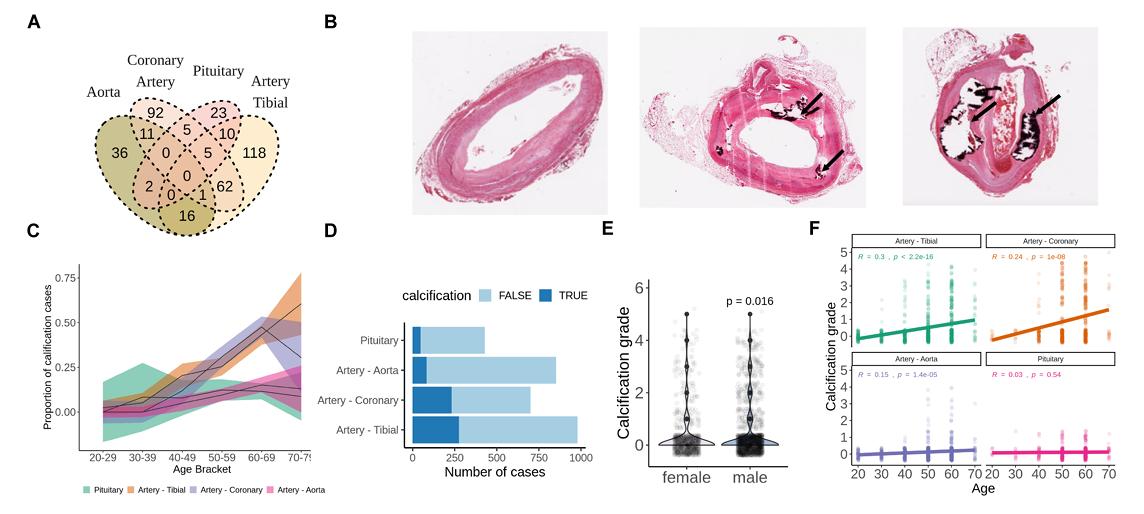
This figure illustrates how calcium accumulates in soft tissues over time and how this process varies by organ, age group, and sex. Panel A highlights how many individuals develop overlapping calcification across multiple areas—most notably in the aorta, tibial artery, coronary artery, and pituitary gland. Microscopic images reveal a clear shift from a healthy arterial structure to severe calcification, which alters tissue integrity.
In Panel C, we see that soft tissue calcification becomes increasingly common with age, particularly after midlife. Panel D identifies the tibial and coronary arteries as the most frequently affected sites across the entire dataset. In Panel E, men show higher calcification grades than women, with the difference reaching statistical significance. Finally, Panel F illustrates that while calcification severity rises steadily with age in the arteries, age has a weaker influence on pituitary gland involvement.
Ibragimova AG, Stanishevskiy YM, Plakkhin AM, et al. Comparative analysis of calcified soft tissues revealed shared deregulated pathways. Front Aging Neurosci . 2023;15:1131548. Published 2023 Jun 14. doi:10.3389/fnagi.2023.1131548
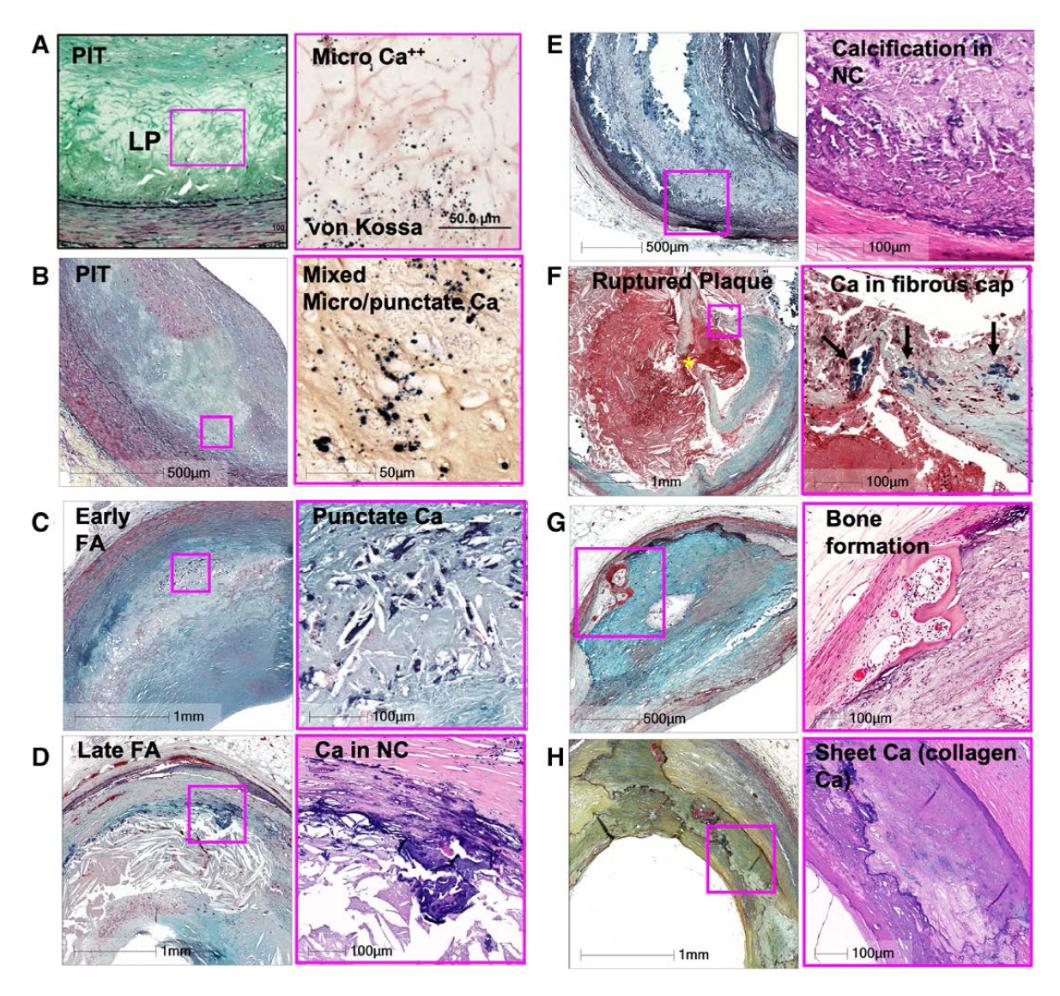
This figure illustrates how calcium accumulates within blood vessel plaques at different stages of atherosclerotic progression. Early on, small calcium particles—measuring between 0.5 and 15 micrometers—can be observed in thickened areas of the intima, often near loose connective tissue or fat-rich regions. As the plaque matures, both microcalcifications and clustered punctate deposits begin to appear together in the same zones.
In early fibroatheroma, these punctate patterns become more clearly defined. As the disease advances, calcium begins to fragment and migrate deeper, reaching the media and infiltrating areas rich in collagen and necrotic debris. In some lesions, calcium collects within the necrotic core itself. In later-stage plaques that have ruptured, calcium is visible in the fibrous cap, with clear disruptions at the rupture site.
In certain regions near the arterial media, bone-like structures begin to emerge, showing signs of ossification. Eventually, large, sheet-like calcium formations develop, often aligning with dense collagen bands and forming organized layers. These histological patterns—revealed using Von Kossa, Movat pentachrome, and hematoxylin-eosin stains—underscore how calcium behavior varies based on tissue type and plaque stage in atherosclerosis.
Onnis C, Virmani R, Kawai K, et al. Coronary Artery Calcification: Current Concepts and Clinical Implications. Circulation . 2024;149(3):251-266. doi:10.1161/CIRCULATIONAHA.123.065657
Cellular Realities That Shift How We Understand well being
Let’s revisit five commonly accepted ideas—then uncover what’s been hiding beneath them.
- Prevailing View: Well-being is felt as an emotional or psychological state.
Deeper Layer: Cellular well-being depends on the fluidity of calcium signaling between and within cells. When calcium builds up inside neurons or muscle fibers, it slows communication and energy flow, producing symptoms that may feel emotional but are rooted in physiological processes.
- Prevailing View: Laboratory calcium levels within normal range mean calcium is not a problem.
Deeper Layer: Most serum calcium reflects inactive, protein-bound calcium. What affects cellular well-being is the ionized, bioactive fraction—mainly how it's regulated by local pH, magnesium, and calcitonin dynamics. A person can have normal labs yet still experience calcium dysregulation at the tissue level.
- Prevailing View: Chronic inflammation is mainly due to immune overactivity, diet, or toxins.
Deeper Layer: Intracellular calcium overload is a direct trigger of inflammasome activation and mitochondrial distress. Without resolving calcium misplacement, inflammatory cycles may persist despite a clean diet, gut repair, or supplements.
- Prevailing View: Deep sleep improves health by resetting hormones and calming the nervous system.
Deeper Layer: The pineal gland’s release of melatonin is calcium-dependent. Pineal calcification—seen in nearly half of adults over 40—blocks this signaling, fragmenting sleep and reducing mitochondrial repair, even if total sleep hours appear adequate.
- Prevailing View: Well-being improves when cortisol is lowered and dopamine is balanced.
Deeper Layer: Neurotransmitter release is triggered by calcium influx at the synapse. When neurons can’t regulate this calcium entry efficiently, emotional regulation suffers, no matter how well the person eats, meditates, or supplements.
Case Reference
A 56-year-old individual who had been taking one daily dose of AIC therapy for seven years showed remarkably high bone mineral density values across the lumbar spine, with T-scores reaching up to 2.8 in the L3–L4 region, equivalent to 128% of age-matched expectations. This long-term outcome reflects not only improved mineral density but also broader support for physiological well-being. According to molecular medicine, well-being is deeply tied to how calcium is distributed and regulated—not just in bones, but across all cellular compartments. AIC therapy, which is known to activate calcitonin release, lower excess calcium in the bloodstream, and redirect it into bone tissue, all without disturbing hormonal balance. In this case, the steady normalization of bone density suggests that calcium was flowing as it should, supporting structural strength and reducing silent calcification risk, which together contribute to a more profound sense of systemic health and long-term cellular well-being.
Conclusion
Across every layer of well-being—mental clarity, emotional steadiness, and physical recovery—calcium functions as a silent conductor, orchestrating the body’s internal rhythms. As tissues age, we begin to see what happens when this rhythm breaks down: calcium quietly hardens arteries, disrupts sleep regulation, and interferes with the brain’s natural flow. Yet restoring balance isn’t about increasing calcium intake. It’s about correcting the way calcium moves.
AIC Therapy supports this process by activating calcitonin and improving the regulation of ionic calcium, guiding it away from soft tissues and back toward the bone. As this flow is restored, the body gradually regains its structural strength, hormonal alignment, and cellular flexibility—without overstimulation or force.
For individuals looking to feel more centered, clear-headed, and physically resilient, helping calcium return to its proper rhythm may be one of the most fundamental and overlooked steps toward true well-being.
Bring calcium signaling into your practice.
Practitioners can request a consultation to discuss AIC therapy and how these mechanisms apply to specific cases.
Newsletter content is educational and contributed by participating healthcare practitioners. These statements have not been evaluated by the FDA and are not intended to diagnose, treat, cure, or prevent any disease.