This newsletter reveals how disrupted calcium handling helps drive anxiety physiology and how restoring calcium balance can shift the system toward steadier neural function.
Executive Summary
Anxiety can be approached as a disorder of calcium signaling, in which altered membrane excitability, intracellular calcium imbalance, and oxidative stress reinforce persistent threat sensitivity. This explains why symptoms such as tingling, cramps, chest tightness, and internal tension reflect disturbed calcium signaling rather than a purely emotional disturbance. AIC Therapy breaks the overactive stress state, reduces internal tension, and restores neural stability that anxiety has disrupted.
Why Anxiety Deserves a Closer Look Through Calcium Signaling
Anxiety can be understood not only as an emotional condition but also as a disorder of calcium signaling in the brain. Calcium ions help neurons translate stress into electrical activity, neurotransmitter release, and adaptive cellular responses. When calcium entry, intracellular storage, and calcium clearance are out of balance, fear circuits can become overactive. This is especially important in the amygdala, hippocampus, and prefrontal cortex, where calcium flux helps set excitability and threat sensitivity. From this starting point, anxiety begins to look like a problem of disturbed ion handling rather than only a problem of mood.
T-type calcium channels make this link between calcium dysregulation and anxiety more specific. These low-voltage-activated channels are widely expressed in stress-responsive brain regions and help shape rhythmic firing and neuronal responsiveness. Evidence suggests a dual role: basal T-type channel activity may support emotional stability, while stress-related overactivation may promote anxiety-related behavior. This helps explain why both excessive channel signaling and loss of physiologic channel balance can be linked to anxious phenotypes. As the discussion moves from membrane channels to intracellular signaling, the same pattern of dysregulation is observed within the cell.
At the intracellular level, anxiety is also linked to disturbed calcium exchange between the endoplasmic reticulum and mitochondria, which can increase oxidative stress and reduce neuronal resilience. This disruption supports membrane excitability, intracellular calcium release, and mitochondrial regulation, all of which contribute to persistent hypervigilance. AIC is relevant because it restores calcium signaling, triggers endogenous calcitonin release, and improves calcium coordination between the mitochondria and the endoplasmic reticulum. Through these effects, AIC reduces neural overreactivity in anxiety and provides a coherent physiology linking calcium imbalance, stress-circuit dysfunction, and symptom expression.
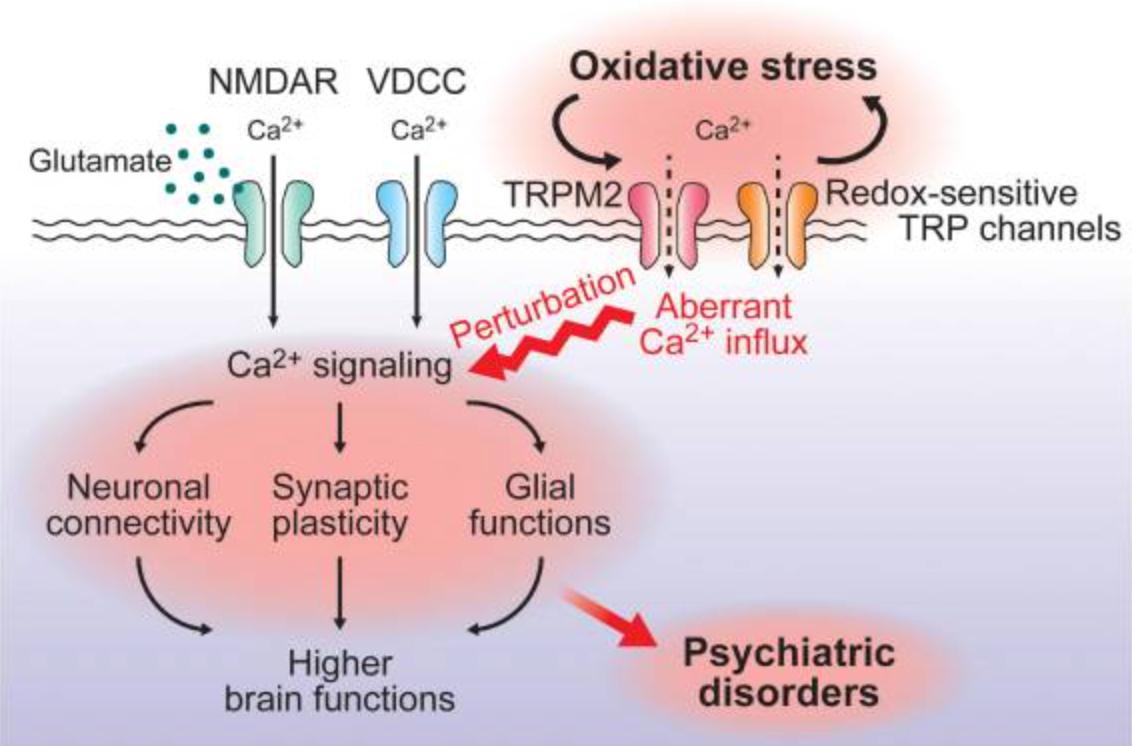
This figure explains a proposed model of how redox-sensitive transient receptor potential channels may contribute to psychiatric disorders. It starts with calcium signaling through voltage-dependent channels or the N-methyl-D-aspartate receptor, which supports neuronal connectivity, synaptic plasticity, and glial function. The figure then places oxidative stress before changes in the expression and activity of redox-sensitive transient receptor potential channels. According to the caption, these channel changes further increase oxidative stress. The caption also states that this process disrupts calcium signaling through the voltage-dependent channel or receptor pathway. In this model, oxidative stress and abnormal calcium signaling are linked within the same disease process. The main message is that psychiatric pathophysiology is presented here as a sequence connecting oxidative load, calcium dysregulation, and altered brain cell function.
Nakao A, Matsunaga Y, Hayashida K, Takahashi N. Role of Oxidative Stress and Ca2+ Signaling in Psychiatric Disorders. Front Cell Dev Biol. 2021 Feb 11;9:615569. doi: 10.3389/fcell.2021.615569. PMID: 33644051; PMCID: PMC7905097.https://creativecommons.org/licenses/by/4.0/
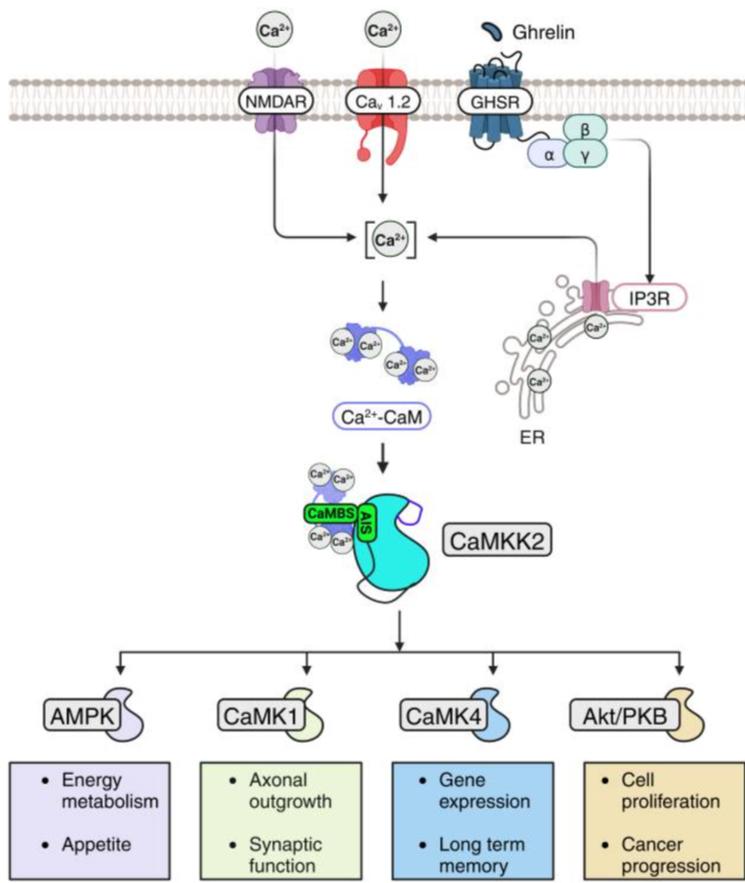
This figure explains how calcium/calmodulin-dependent protein kinase kinase 2 (CaMKK2) links calcium entry at the cell surface to downstream cellular signaling. It is activated by membrane depolarization, neurotransmitters, and hormones that raise intracellular calcium and increase formation of the calcium-calmodulin complex. The main cell surface activators named here are the voltage-gated calcium channel CaV1.2, the N-methyl-D-aspartate receptor, and the ghrelin receptor. CaMKK2 then decodes these calcium signals by activating four downstream pathways. These pathways are calcium/calmodulin-dependent protein kinase 1, calcium/calmodulin-dependent protein kinase 4, AMP-activated protein kinase, and Akt/protein kinase B.
The text also states that CaMKK2 activates each of these substrates by phosphorylating a key threonine residue in the kinase domain's regulatory activation loop. Through these downstream pathways, CaMKK2 regulates cellular activities that are important for brain function and whole-body energy homeostasis.
McAloon LM, Muller AG, Nay K, Lu EL, Smeuninx B, Means AR, Febbraio MA, Scott JW. CaMKK2: bridging the gap between Ca2+ signaling and energy-sensing. Essays Biochem. 2024 Nov 18;68(3):309-320. doi: 10.1042/EBC20240011. PMID: 39268917; PMCID: PMC11576191. https://creativecommons.org/licenses/by/4.0/
Clinical Tips
- Panic-like symptoms accompanied by perioral tingling, carpopedal spasm, cramps, or marked chest tightness may reflect respiratory alkalosis with reduced ionized calcium rather than anxiety alone. Total calcium may remain normal even when the biologically active fraction has fallen enough to produce symptoms.
- Mild primary hyperparathyroidism can resemble an anxiety presentation before it is recognized as an endocrine disorder. Anxiety accompanied by constipation, kidney stones, polyuria, or high-normal to mildly elevated calcium warrants closer attention to the calcium-PTH axis. 3. In patients labeled as anxious, fingertip tingling, perioral paresthesia, muscle cramps, tetany, or unexplained QT prolongation may indicate symptomatic hypocalcemia rather than a primary psychiatric process. Neuromuscular irritability often appears before an obvious laboratory abnormality. 4. In calcium-related anxiety evaluations, interpretation is often as important as measurement. Ionized calcium is the biologically active fraction, and pH shifts or albumin correction, particularly in hypoalbuminemia, can make total calcium appear falsely reassuring.
Clinical Snapshot
This case shows the value of AIC therapy in a patient whose inflammatory joint disease had come to affect more than pain and swelling, extending into sleep disruption, emotional strain, and loss of daily stability. A 53-year-old woman presented with severe knuckle and knee arthritis, with persistent pain, visible swelling, and nightly reliance on heating pads as her symptoms increasingly began to shape the rhythm of her life. Before AIC therapy, medicines and supplements had not restored comfort, function, or physical ease, and the constant burden of pain kept her in a state of exhaustion and internal tension.
After AIC therapy, both pain and swelling were reduced significantly, joint comfort improved, and the cycle of nightly suffering eased. Disrupted calcium handling contributes to both inflammatory tissue stress and neural overreactivity. By restoring calcium signaling, triggering endogenous calcitonin release, and stabilizing calcium homeostasis, AIC shifts the system from persistent excitation toward physiologic recovery. By reducing oxidative stress and limiting ongoing cellular injury, it supports stronger tissue resilience, improved functional stability, better overall health, and a lower disease burden. The physical improvement and the recovery of emotional steadiness are therefore presented as parts of the same biological response.
Conclusion
Anxiety is best understood here as a disorder of calcium regulation that amplifies fear circuitry and sustains body-wide stress. When membrane calcium entry, intracellular calcium handling, and endoplasmic reticulum-to-mitochondrial coordination are out of balance, oxidative stress rises and neuronal resilience declines, making hypervigilance more persistent. This is also why tingling, cramps, carpopedal spasm, or chest tightness should prompt consideration of ionized calcium, even when total calcium does not look alarming.
Clinical recovery begins when this calcium-driven state is stabilized, rather than when it is divided into separate emotional and physical complaints. As calcium homeostasis improves, better sleep, less internal tension, lower pain, and reduced swelling can be understood as parts of the same shift toward steadier function. AIC Therapy is expected to restore calcium signaling and improve coordination between the endoplasmic reticulum and mitochondria, thereby directly supporting calmer neuronal firing and less persistent threat sensitivity. That makes it relevant to anxiety not only because it acts on the disrupted physiology, but because it helps loosen the cycle in which overactivation keeps the patient tense, exhausted, and less able to regain daily stability.
Bring calcium signaling into your practice.
Practitioners can request a consultation to discuss AIC therapy and how these mechanisms apply to specific cases.
Newsletter content is educational and contributed by participating healthcare practitioners. These statements have not been evaluated by the FDA and are not intended to diagnose, treat, cure, or prevent any disease.