Listen to this issue
This newsletter reveals how a raised resting calcium level erases new memories before they can last.
Executive Summary
Early forgetfulness shows a telling pattern: today's events slip away while old memories stay sharp. Recent memories return only in outline, sleep breaks up, and the same questions repeat. The memory-building regions run on calcium, and a raised resting level blunts the writing signal. This calcium problem sits at three places: the cell surface, the internal stores, and the mitochondria. The earliest change is functional and reversible, before any neuron is lost. Bringing the resting calcium back into order sharpens the signal, and memory holds again.
Why new memories fade fast when a neuron's resting calcium sits too high.
Early forgetfulness usually means new memories form but do not last. The brain still registers a new name or conversation. Minutes later, the memory is gone. Neurons run memory on brief, sharp calcium signals. Between those signals, resting calcium must stay low. With age, that resting level drifts upward. In early Alzheimer's, it reaches nearly twice the normal level. This steady excess is where memory loss begins. Whether a memory stays or fades depends on the calcium a connection sees. A brief, strong calcium surge in a single active connection encodes a memory. A smaller, steady rise spread across many connections wipes them out. Normally, this erasing signal is confined to deep sleep. During sleep, the brain sorts memories, keeping some and clearing others. These sleep signals run on well-timed calcium, too. A raised resting calcium level imitates that same erasing signal. Now it runs during waking hours, well beyond sleep. So a fresh memory is wiped soon after it forms. This is the forgetfulness of early cognitive decline. New learning does not stick.
Holding onto memories means bringing the neuron's resting calcium back down. The steady excess keeps the erasing signal switched on. It also loosens the strong connections that store memories. The disorder sits where calcium first drifted out of range. These are the cell surface, the internal calcium stores, and the mitochondria. When resting calcium settles, the erasing signal returns to sleep alone. New memories then survive long enough to consolidate overnight. Anti-orbital Ionic Calcium Therapy (AIC) restores the resting calcium set-point across the surface, stores, and mitochondria. The clinical reading is memory that holds: what is learned today is still there tomorrow.
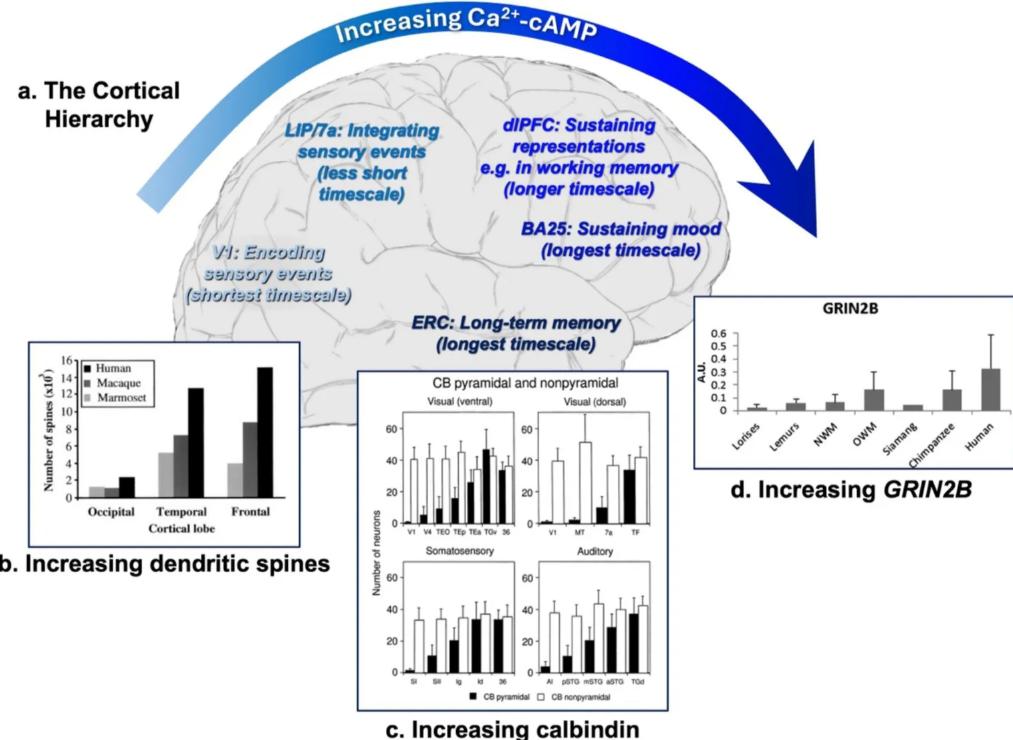
This figure explains why the brain's memory regions rely most on calcium signaling. The cortex forms a hierarchy, topped by the areas for emotion and long-term memory. Moving up this hierarchy, neurons hold information longer and gain more connections on their spines. These higher neurons also build more calcium-signaling machinery inside their excitatory cells. They make more of the receptor subunit that admits the highest levels of calcium. They also make more calbindin, a protein whose amount marks heavy calcium use. So the regions that generate long-term memory depend most on strong calcium signaling.
Bastioli, G.; Piccirillo, S.; Graciotti, L.; Carone, M.; Sprega, G.; Taoussi, O.; Preziuso, A.; Castaldo, P. Calcium Deregulation in Neurodegeneration and Neuroinflammation in Parkinson’s Disease: Role of Calcium-Storing Organelles and Sodium–Calcium Exchanger. Cells 2024 , 13 , 1301. https://doi.org/10.3390/cells13151301. https://creativecommons.org/licenses/by/4.0/
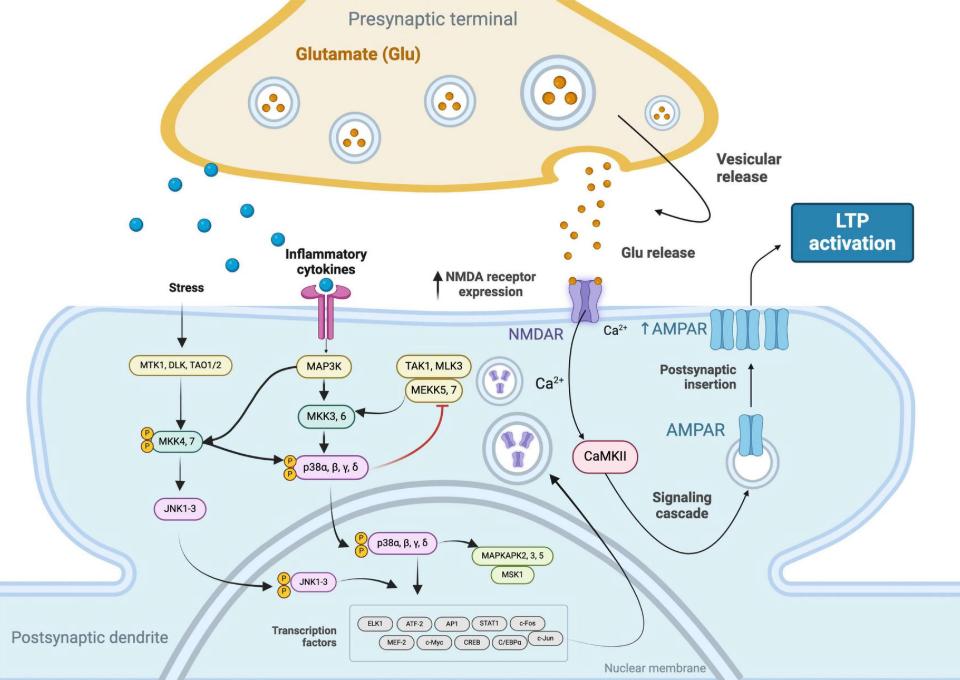
This figure illustrates how an increase in calcium strengthens a synapse, leading to a lasting memory. Stress signals and inflammatory messengers switch on an internal cascade in the neuron. That cascade increases the production of NMDA receptors, the main glutamate receptors. With more of these gates, the synapse responds more strongly to glutamate and admits more calcium. The rise in internal calcium switches on a calcium-activated enzyme inside the cell. That enzyme drives the neuron to add more AMPA receptors at the synapse. More receptors make the connection stronger and longer-lasting, the cellular basis of memory.
Bastioli, G.; Piccirillo, S.; Graciotti, L.; Carone, M.; Sprega, G.; Taoussi, O.; Preziuso, A.; Castaldo, P. Calcium Deregulation in Neurodegeneration and Neuroinflammation in Parkinson’s Disease: Role of Calcium-Storing Organelles and Sodium–Calcium Exchanger. Cells 2024 , 13 , 1301. https://doi.org/10.3390/cells13151301 https://creativecommons.org/licenses/by/4.0/
Clinical Tips
- Old memories stay vivid while today's events vanish, marking a retention lesion, not a broad decline.
- Broken night's sleep and daytime drowsiness travel with the earliest forgetting. The overnight rhythm that files memories is the first to slip.
- The earliest tissue change is loss of the largest, strongest synapses, not dying neurons. Memory capacity falls as these strong contacts thin out.
- Neuron counts stay near normal while memory already fails, an early reversible synapse lesion.
- AIC steadies neuronal calcium while the synapse lesion is still reversible. New day-to-day memories begin to hold before the loss sets.
Clinical Snapshot
You have met the person who remembers that a conversation happened, but not what was said. The event survives in outline. The details are gone. This is not inattention, and it is not a hearing problem. It is a memory that formed without its details. Writing a detailed memory needs a sharp, pinpoint calcium signal. It must fire in the exact synapses that carried the event. That signal has to stand out against a quiet calcium background. In early forgetting, resting calcium levels are too high throughout the neuron. The pinpoint signal loses its contrast against that raised background. So the brain records that something happened, but not the specifics. Recent memories come back coarse, gist-only, stripped of the particulars.
This pattern is worth catching because it is so easy to dismiss. Remembering that, but not what, is an early signal, not a personality quirk. It points to a calcium signaling problem inside the memory circuits. The information is arriving; the machinery that files it with detail has lost its edge. Watch for recollection that keeps the frame and drops the content. The person recalls that an event occurred, but none of its particulars. That pattern belongs to the calcium signal, not to effort or mood. AIC lowers the raised background calcium and sharpens the pinpoint signals that encode detail. As the contrast returns, recollection comes back with its specifics, and its detail holds.
Conclusion
Forgetfulness begins as a calcium signaling problem in the regions that build memory. Those regions lean hardest on calcium, and writing a memory needs a sharp calcium surge. When the resting calcium climbs above its normal set-point, that surge loses its edge. New memories fade while older ones hold, and what returns comes back stripped of detail.
The earliest change is functional and reversible, arriving before any neuron is lost. Holding memory depends on bringing that raised calcium back down. Steady the calcium where it drifted, and the sharp memory-writing surge returns. AIC restores coordinated calcium signaling across the memory circuits. By resetting the resting calcium early, it protects memory while recovery is still possible.
Bring calcium signaling into your practice.
Practitioners can request a consultation to discuss AIC therapy and how these mechanisms apply to specific cases.
Newsletter content is educational and contributed by participating healthcare practitioners. These statements have not been evaluated by the FDA and are not intended to diagnose, treat, cure, or prevent any disease.