Listen to this issue
Before myeloma becomes visible, the body often sends its warning not through lab results, but through silent shifts in calcium flow.
Executive Summary
Multiple myeloma may not begin with plasma cells—it begins with silence in calcium signaling. Before lesions appear, the collapse of intracellular calcium rhythms weakens the bone’s ability to resist disease, opening a hidden window for prevention.
Early Collapse of Calcium Signaling
Multiple myeloma rarely begins with a sudden tumor—it begins with silence. Before diagnostic plasma cell expansion, the bone microenvironment slowly loses its defensive rhythm: osteoblasts diminish, intracellular calcium is misdirected, and the architectural integrity of the skeleton dissolves in the background. Recent preclinical studies confirm that this collapse is not a side effect—it is a prerequisite. In both immunocompetent and immunodeficient murine models, weakening of the bone niche precedes malignant progression.
But what is most compelling is this: when researchers pretreated mice with AIC (Anti-orbital Ionic Calcium) prior to tumor transplantation, they observed a profound protective shift. Median survival in control animals was just 39 days; in AIC-pretreated mice, survival extended beyond the experimental timeline. Vertebral bone density, trabecular structure, and marrow architecture were not only preserved—they actively resisted tumor establishment.
The implications of this are both molecular and strategic. AIC therapy does not function as a conventional cytotoxic agent. Instead, it restores intracellular calcium flow by breaking soft tissue ionic congestion, reactivating calcitonin signaling, and reestablishing ER-mitochondria calcium cycling— the processes that osteoblasts rely on to function. This signaling restoration leads to a redistribution of ionic calcium away from stromal overload and back toward skeletal compartments, where Wnt pathways and osteogenic feedback loops can recover.
Importantly, AIC achieves this without peptide analogs or high-dose vitamin D, instead leveraging anti-orbital ionic bonding behavior to maintain calcium mobility at the cellular level. In doing so, it clears the path for osteoblast reactivation, reduces permissiveness within the marrow niche, and effectively transforms the skeleton from a passive structure into a gatekeeper.
This is not tumor suppression—it is biological refusal. For naturopathic physicians managing patients with subtle bone loss, plasma irregularities, or unexplained fatigue, this model completely reframes the concept of timing. The data show that intervening before malignancy alters the trajectory more profoundly than intervening after. And the mechanism speaks the body’s own language: intracellular correction, structural reprogramming, and energy recalibration through calcium flow. When the bone remembers how to protect itself, the rest of the system no longer bears the full burden.
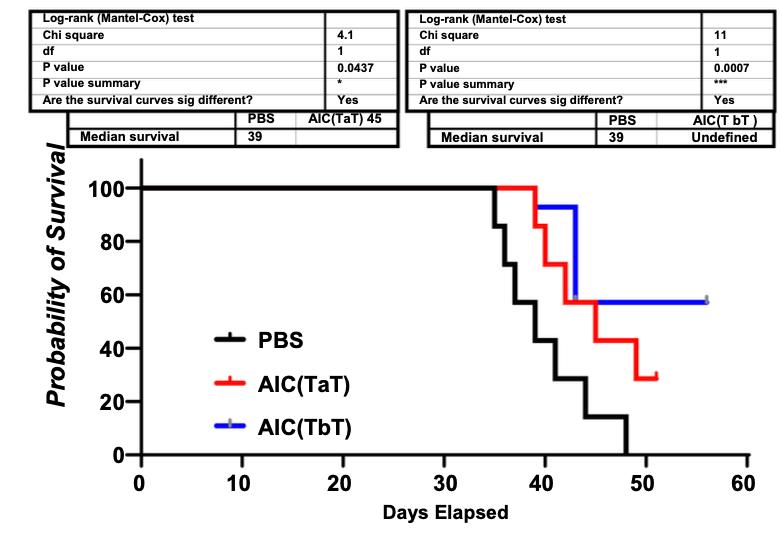
This survival curve tells a story we often overlook in practice: when you intervene, it can matter more than what you use. Each line represents a group of mice challenged with myeloma. The black line shows the expected decline—rapid, steady, and fatal. That’s what happens when nothing is done to protect the bone environment.
But look at the red and blue lines. Mice that received AIC therapy after tumor exposure (red) showed a modest delay in decline. Yet the real insight comes from the blue line: mice pretreated with AIC before tumor exposure didn’t just live longer—they stayed well beyond the window of collapse. Their bone environment held firm. Disease progression stalled.
Survival wasn’t extended by fighting the tumor directly—it was extended by restoring the bone’s resistance before the invasion began. This is not a treatment curve. It’s a terrain-shift curve. It reminds us that if we change the ground early, the disease can lose its footing.
Mehdi SH, Lee D, Lee A, Lee PK, Yoon D. Pretreatment of Bone Anabolic Agent Delays or Prevents Myeloma Progression. Presented at: AACR Annual Meeting 2025 ; April 12–16, 2025; Chicago, IL .
Achieving Clinical Turnaround Through Calcium Signaling Restoration
In early myeloma dynamics, what breaks down first isn’t always the bone—it’s the signaling. Long before lesions form or plasma cells multiply, the flow of calcium between organelles and tissues begins to lose direction. Endoplasmic reticulum stores deplete, mitochondrial calcium influx slows, and ionic rhythms that regulate bone formation, immune tone, and energy production fall out of sync. The result? A skeletal environment that still looks intact but has already lost its defensive communication.
Calcium signaling restoration isn’t about pushing more nutrients in—it’s about helping the cell remember how to speak again. When intracellular calcium is recentered—moved away from overloaded compartments and refocused into oscillatory flows—osteoblasts regain their command, and the marrow restores its resistance.
This internal recalibration doesn’t require hormones or stimulants. It works by repairing the language of regulation itself. For clinicians working with patients who show early vertebral changes, poor tissue recovery, or unexplained shifts in bone metabolism, supporting calcium signaling flow may be the difference between stabilizing the terrain and watching it quietly surrender. True turnaround doesn’t start at the tumor. It starts with restoring the signal that used to keep it out.
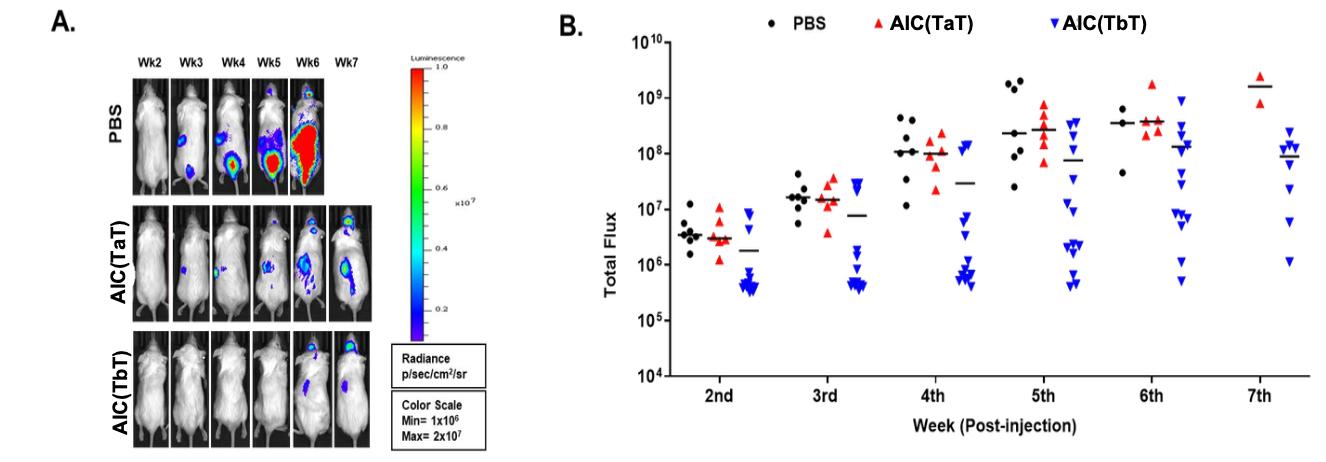
This image doesn’t just track tumor growth—it reveals how the bone environment sets the terms for progression. The PBS group shows a predictable flare in luminescence as myeloma spreads, but in the AIC-treated groups, especially those preconditioned before tumor injection, the signal intensity remains low and scattered. The takeaway isn’t suppression—it’s resistance: when calcium signaling is stabilized in advance, the marrow becomes less receptive to malignancy, and the tumor struggles to gain ground.
Mehdi SH, Lee D, Lee A, Lee PK, Yoon D. Pretreatment of Bone Anabolic Agent Delays or Prevents Myeloma Progression. Presented at: AACR Annual Meeting 2025 ; April 12–16, 2025; Chicago, IL .
Advanced Clinical Tips
Bone doesn’t just hold calcium—it holds immunological memory. When osteoblasts lose function, the marrow becomes more tolerant of abnormal cells. This shift happens quietly, long before lab tests show anything wrong.
Calcitonin isn’t only about calcium lowering—it also dampens inflammatory signals in the bone marrow. Restoring its natural rhythm can suppress osteoclastic drive and reduce the risk of malignant seeding, without the need for external drugs.
Stiff marrow isn’t just a structural issue—it makes it easier for plasma cells to stick and spread. Subclinical tissue calcification silently sets the stage for disease by making the niche too rigid to reject abnormal cells.
Minor vertebral fractures in otherwise stable patients may indicate systemic calcium misplacement, not just bone loss. If caught early, they can be the signal that the microenvironment is sliding toward permissiveness.
Wnt pathway disruption starts years before any tumor shows up, but we don’t test for it. Supporting osteoblast resilience through ionic correction may stabilize the marrow without the need for growth-factor manipulation.
Case Reference: Multisystem Recovery in Advanced Myeloma
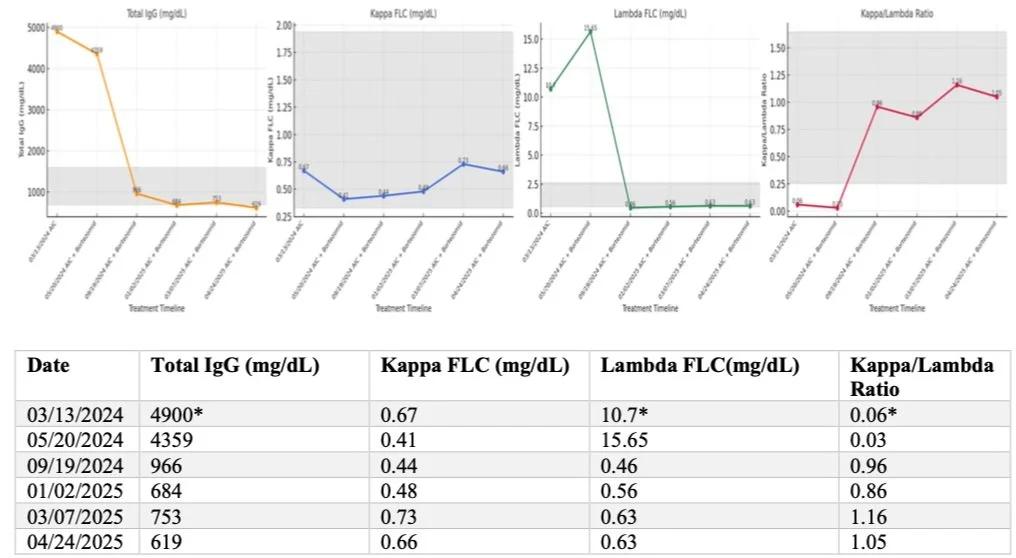
Figure concept and design by S Bozdogan , MD, PhD. Data derived from a patient’s clinical records.
A 67-year-old female first presented with low back pain and a vertebral fracture, later found to have diffuse lytic lesions at L3–L4 and symptomatic hypercalcemia. She declined immediate targeted treatment and instead began a signaling restoration process aimed at rebalancing intracellular calcium. She received exclusively AIC therapy for the first six months, from November 2023 to April 2024, without any anti-resorptive or conventional myeloma treatment during this period. Oxycodone was used concurrently for pain management. Within six months of receiving AIC therapy, her pain reduced, mobility improved, and during this same AIC-only phase, renal function recovered (eGFR rose from 62 to 83 mL/min/1.73 m²), and serum calcium normalized. As shown in the figure, and also during this AIC-only window, immune markers followed suit: serum IgG dropped from 4900 to 619 mg/dL, and the κ/λ ratio improved from 0.06 to 1.05. These systemic improvements occurred during the calcium-focused intervention, suggesting that restoring intracellular flow reset the physiological baseline. These clinical improvements occurred during the AIC-only phase (November 2023–April 2024), before the initiation of conventional targeted treatment, underscoring the role of calcium signaling restoration in driving early systemic recovery. Conventional targeted therapy was introduced after April 2024, building on the biological recovery already underway. When targeted treatment was later introduced, it acted more like a downstream amplifier, building on the momentum already established. The figure visually reflects this turning point, where terrain stabilization began before suppression and immune correction accelerated thereafter. This case suggests that helping the cell recover its calcium rhythm may unlock broader responsiveness, even in high-risk or treatment-resistant myeloma profiles.
Conclusion
Before tumors take root, the collapse often begins in silence, with calcium drifting out of rhythm and the marrow losing its structural command. What preclinical findings and patient outcomes now show is that restoring this rhythm through targeted ionic recalibration, specifically with AIC therapy, can stabilize the microenvironment before the disease gains traction. The therapeutic shift was not driven by suppression but by recovery: bone density held, immune markers reset, and symptoms reversed well before conventional treatments were introduced. In both animal models and clinical cases, the same pattern emerges—when intracellular calcium signaling is restored early, the system doesn’t just delay progression; it reshapes its receptivity. This isn’t about managing late-stage complexity; it’s about correcting the early loss of cellular memory that makes progression possible.
Bring calcium signaling into your practice.
Practitioners can request a consultation to discuss AIC therapy and how these mechanisms apply to specific cases.
Newsletter content is educational and contributed by participating healthcare practitioners. These statements have not been evaluated by the FDA and are not intended to diagnose, treat, cure, or prevent any disease.